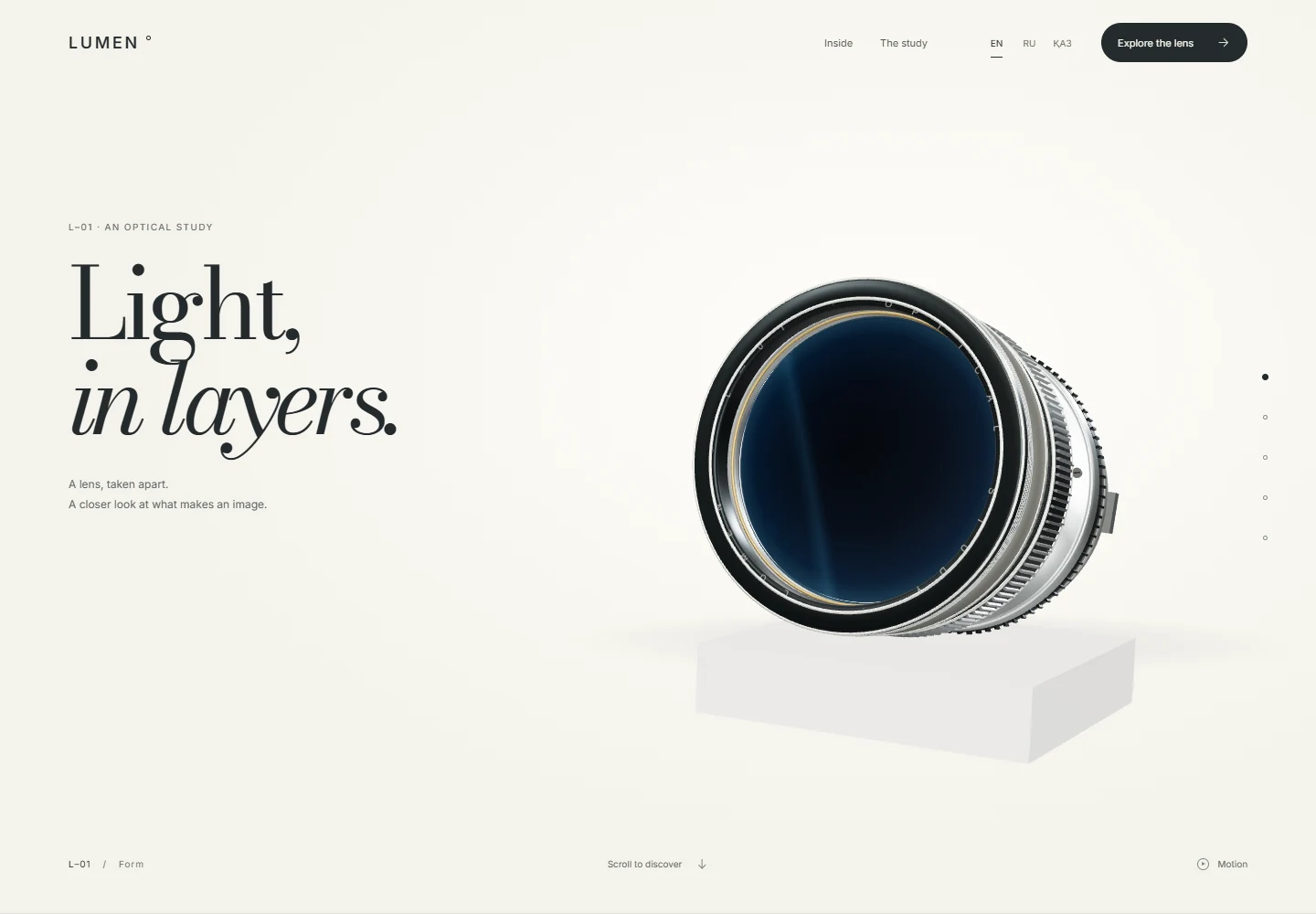
Scrolling moves the iris and separates nine lens groups. Scroll back to reassemble the model.Scrollingmovestheirisandseparatesninelensgroups.Scrollbacktoreassemblethemodel.
LUMEN L-01 in an earlier scene. The current application shows the lens without a case.
01
Getting started
Scroll through the page or use the chapter buttons and keyboard. The interface supports English, Russian and Kazakh.Scroll through the page or use the chapter buttons and keyboard. The interface supports English, Russian and Kazakh.
02
The result
Inspect the assembled lens and its parts, follow the moving iris, and open the gallery. Without WebGL, a static image replaces the 3D scene.Inspect the assembled lens and its parts, follow the moving iris, and open the gallery. Without WebGL, a static image replaces the 3D scene.
03 / Case study
How it works
01
The lens, its groups and moving iris use procedural Three.js geometry.The lens, its groups and moving iris use procedural Three.js geometry.
02
Scroll position controls the assembly stage. Nine groups separate and return to their positions when you scroll back.Scroll position controls the assembly stage. Nine groups separate and return to their positions when you scroll back.
03
Chapter buttons let you select a stage with the keyboard. Without WebGL, still images and component notes remain available. Reduced motion shows the assembled lens without the disassembly animation.Chapter buttons let you select a stage with the keyboard. Without WebGL, still images and component notes remain available. Reduced motion shows the assembled lens without the disassembly animation.
04 / Case study
Project limits
A fictional lens for visual demonstration. The model is not an optical simulation, manufacturing drawing or statement of product performance.A fictional lens for visual demonstration. The model is not an optical simulation, manufacturing drawing or statement of product performance.